

Outages are among the biggest challenges in operating modern IT infrastructures. A server stops responding, a container crashes, an application loses its connection to a database, or a service suddenly requires significantly more resources than expected. In traditional infrastructures, this usually means: identifying the problem, analyzing the cause, intervening manually, and then verifying that the system is working again. In modern cloud environments, some of these processes can be automated.
Self-healing systems independently detect certain error conditions and automatically initiate recovery measures. This allows applications and infrastructure components to continue operating stably even when individual components fail. Self-healing truly realizes its potential when combined with managed cloud services, Kubernetes, monitoring, and automation. Instead of requiring manual intervention for every problem, the platform can respond to defined conditions and, for example, restart a faulty container, move a workload to another node, or provision additional resources.
What Does Self-Healing Mean in the Cloud?
The term “self-healing” refers to an IT system’s ability to automatically detect errors or anomalies and take appropriate measures to restore a defined operational state.
The principle can be illustrated as follows:
Detect deviation → Evaluate status → Implement corrective action → Verify status.
Here’s a simple example: A container hosts a web application. For unknown reasons, the process running inside it terminates. Without self-healing, the application remains unavailable until the container is manually restarted. With self-healing, however, an orchestration platform can detect that the container no longer matches the desired state. It automatically restarts it. The system then checks whether the application is functioning correctly again.
The key point here is this: Self-healing does not mean that a cloud can completely resolve every technical problem on its own. Rather, it means that known and automatable error conditions can be handled without manual intervention. This makes self-healing an important component of modern cloud automation and reliability.
Why are self-healing systems important?
Modern applications increasingly consist of numerous interconnected components. Microservices, containers, APIs, databases, message queues, and other services together form an application. The more complex an environment becomes, the more difficult it is to manually resolve every single error. At the same time, cloud applications often run around the clock. An outage at 3:00 a.m. is just as critical as a problem during normal business hours.
Self-healing can offer several advantages here:
- Faster Response to Errors
- Fewer manual interventions
- Higher availability
- Reduced downtime
- Reduced workload for IT teams
- Standard processes that can be automated
- Improved operational scalability
- More Consistent Responses to Recurring Errors
This is particularly relevant for managed cloud services: The more standardized operational tasks can be automated, the more IT teams can focus on complex tasks and the further development of their applications.
The NWS Newsletter
New products, fresh features and dates for events and talks: everything important from the NWS world, delivered compactly to your inbox.
How a Managed Cloud Automatically Detects and Resolves Outages
For something to be able to self-heal, it must be able to do two things: It must constantly be aware of its own status and have an appropriate response ready for any deviations. This is precisely where a managed cloud demonstrates its strengths, since both components are already set up, tested, and coordinated with one another.
Monitoring and health checks serve as an early warning system
It all starts with the question: “Are you okay?” The system asks it constantly, often several times a minute. Health checks verify that a service is not only running but is actually functioning properly. A process can be technically active yet still fail to respond to a single request. A good health check can tell the difference.
Behind this is a sophisticated monitoring system that continuously tracks metrics such as CPU load, memory usage, response times, and error rates. At NWS, we rely on the proven open-source tools Icinga and Prometheus for this. They not only provide the current status but also identify trends. And trends are worth their weight in gold, because a slow increase in memory usage often signals an outage before it even happens.
Automatic countermeasures: restart, failover, or scaling
As soon as a health check triggers an alert, the appropriate response is initiated. The specific response depends on the problem. The most common response is an automatic restart. If a service is hanging or has crashed, the system restarts it. In many cases, this resolves the problem before a user even notices it.
If that’s not enough, failover comes into play. If an entire server goes down, a standby server takes over. Traffic is rerouted, and the application continues to run on the new hardware. Your customers can continue to use the service while the next node is brought online in the background. And if the problem isn’t a failure but rather the load, automatic scaling helps. When demand increases, the system spins up additional instances. When demand drops again, they are shut down. This protects against overload and saves costs at the same time, since you only pay for the resources you actually use.
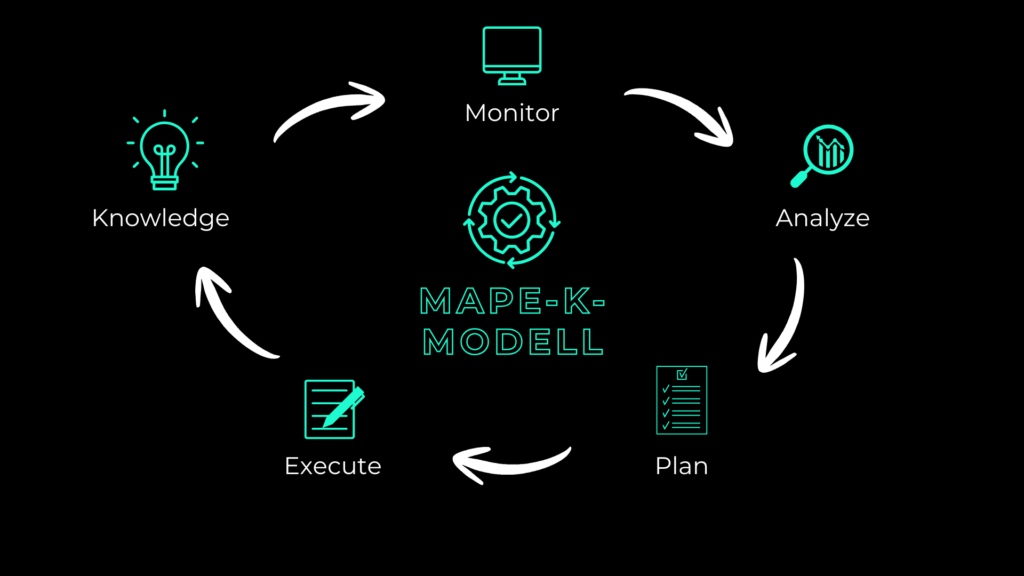
The Four-Stage Control Cycle (MAPE-K)
Self-healing systems operate continuously according to a fixed logical cycle, often referred to as the MAPE-K model:
- Monitor: Agents and probes continuously collect telemetry data (metrics, logs, traces) from servers, containers, and applications.
- Analyze: The system compares the real-time data with defined thresholds or uses AI (AIOps) to detect anomalies.
- Plan: If a problem is identified (e.g., a crashed service or memory shortage), the system determines the appropriate countermeasure using scripts or playbooks.
- Execute: The corrective action is initiated automatically.
- Knowledge: The system draws on a knowledge base or learned patterns to make informed decisions.
Typical Scenarios and Automated Solutions
In a managed cloud environment, self-healing mechanisms kick in for various types of problems:
| Error Type | Cause | Automatic Response (Self-Healing) |
| Application Crash | Software bug, memory leak | The affected container (e.g., in Kubernetes) or virtual machine is restarted immediately . |
| Hardware Failure | Server failure at the data center | The affected workloads are automatically moved to healthy physical servers via live migration. |
| Peak Traffic | Sudden surge in visitors | Auto-Scaling automatically spins up additional instances, and the load balancer redistributes the traffic. |
| Faulty Update | New Software Version Causes Errors | The system automatically rolls back to the latest stable version. |
| Lack of storage space | Hard Drives / Logs Filling Up | Automatic cleanup scripts delete old caches, or storage capacity is dynamically expanded. |
The Role of Monitoring and Observability
Self-healing is only possible with reliable information about the system’s status. Monitoring and observability are therefore central components of an automated cloud infrastructure.
Monitoring answers questions such as the following:
- Is the service available?
- What is the CPU utilization?
- How many errors occur?
- How many requests are being processed?
Observability takes it a step further and helps make the internal state of complex systems transparent through metrics, logs, and traces. This is especially important when it comes to microservices. After all, when an application consists of dozens or hundreds of services, the question “Is the server online?” is no longer sufficient.
Instead, the following must be identified, for example:
User Request → Frontend → API → Service A → Service B → Database
If Service B isn’t responding, the platform must detect the error as quickly as possible and respond accordingly.
Self-healing in databases: a particular challenge
A failed web server can usually be replaced relatively easily. Automatic database recovery, on the other hand, is much more complex. A database contains data whose consistency must be maintained. Therefore, simply starting a new container is not enough. Depending on the architecture, the following mechanisms may be required, for example: replication, failover, high availability, automated backups, point-in-time recovery, redundant storage, database clusters, or regular restore tests.
This highlights an important limitation of self-healing: An automatically restarted service does not necessarily mean that the underlying data has been restored. Self-healing must therefore always be considered within the context of the overall system architecture.
Self-Healing in Practice: The Example of Kubernetes
Anyone talking about self-healing will inevitably end up discussing Kubernetes sooner or later, because the concept of self-healing is deeply integrated into it. Kubernetes constantly compares the desired state with the actual state and automatically corrects any discrepancies between the two.
Three mechanisms illustrate this particularly well:
- Liveness probes ask, “Is this container still alive?” If it doesn’t respond, it is restarted. This catches hung processes that are technically still present but are no longer performing any work.
- Readiness probes check whether the container is ready to receive requests. As long as the answer is “No,” it does not receive any traffic. This ensures that requests do not end up at an instance that is still starting up or is currently overloaded.
- ReplicaSets keep track of the count. You want three instances, but only two are running? Kubernetes automatically starts a third one without prompting you. If an entire node fails, the scheduler redistributes the affected containers to healthy nodes.
The result is an infrastructure that can handle minor disruptions without anyone even noticing. A managed Kubernetes environment provides exactly this foundation, without requiring you to build and maintain it from scratch yourself.
Self-healing must therefore always be considered within the context of the overall system architecture.
What benefits does self-healing offer companies?
Self-healing is not just a technical gimmick. Automated recovery can provide tangible business benefits.
- Downtime: The faster a problem is detected and resolved, the shorter the downtime.
- Higher Availability: Redundancy and automatic recovery can improve the availability of business-critical applications.
- Less routine work: IT teams don’t have to manually perform every single container restart or standardized recovery process.
- Faster response: Automated systems can respond within seconds—regardless of whether an administrator is currently monitoring the system.
- Better scalability: As the number of services increases, manual management becomes increasingly difficult. Automation enables the operation of larger environments.
- Standardized processes: A defined error condition can always be handled according to the same rules.
Self-Healing vs. Traditional IT Operations
The difference can be explained simply:
| Traditional Operation | Self-Healing Cloud |
| Error occurs | Error occurs |
| Monitoring reports a problem | Monitoring Detects a Problem |
| Administrator analyzes | Automation Assesses Condition |
| Manual Restart | Automated Recovery |
| Administrator Checks System | Health Check checks the system |
| Operation is restored | Operations are automatically restored |
| Post-incident analysis | Analysis can be performed in parallel |
Of course, this distinction becomes blurred in practice. Even modern self-healing systems require human intervention, especially when dealing with complex or unknown errors. The main difference lies in how many standardized problems can be handled automatically.
What Self-Healing Cannot Do
As powerful as automated recovery mechanisms may be, self-healing is not a universal solution. There are numerous situations in which human analysis remains necessary.
- Software errors: If a program processes incorrect data due to a bug, restarting it may not help. The error will then occur again.
- Incorrect configuration: An incorrect configuration can cause a service to fail repeatedly. Here, too, self-healing can only address the symptom.
- Data errors: Corrupted or inconsistent data cannot generally be resolved by restarting a container.
- Security incidents: In the event of a security incident, an automated restart may not be sufficient. Analysis, isolation, and targeted measures are required here.
- Cascading failures: If multiple interdependent services fail simultaneously, simple recovery logic may not be sufficient.
- Misguided automation: Poorly configured automation can actually make problems worse.
That is why recovery mechanisms must be carefully tested and monitored. Self-healing requires a defined target state. A particularly important aspect of self-healing is defining what is considered a normal state in the first place. Without a defined target state, a system cannot reliably determine whether a deviation exists.
In Kubernetes, this desired state could be defined as follows, for example: replicas: 3. Put simply, this means: “Three instances should be available.” The platform continuously compares the desired state with the actual state. It is precisely this desired-state model that is a fundamental component of modern cloud-native architectures.
The Prerequisites for Effective Self-Healing
Self-healing does not happen automatically simply because an application is moved to the cloud. It requires an appropriate technical foundation.
- Redundancy: An application can only automatically switch to another instance if the necessary resources are available.
- Monitoring: The system must be able to detect when an error occurs.
- Health Checks: It must be defined what “healthy” or “functional” means.
- Automation: Specific actions must be defined to respond to certain error conditions.
- High Availability: Critical components should be designed with redundancy.
- Good Architecture: Stateless services are often better suited for automated recovery than tightly coupled monolithic systems.
- Backup and Recovery: Self-healing is no substitute for backups.
- Observability: In complex systems, causes and dependencies must remain traceable.
Planning Self-Healing Effectively: What Companies Should Keep in Mind
Anyone looking to implement self-healing in a managed cloud should not simply enable as many automated actions as possible. Instead, a structured approach is recommended.
Step 1: Identify Critical Services:
Which applications require particularly high availability?
Step 2: Define error states:
Which conditions can be automatically detected?
Step 3: Define recovery measures:
What response is appropriate for which error?
Step 4: Implement health checks:
How can we reliably determine whether an application is functioning properly?
Step 5: Set up monitoring and alerting:
Which metrics and events need to be monitored?
Step 6: Test the automation:
What actually happens when a pod, node, or service fails?
Step 7: Test failover regularly:
A self-healing system shouldn’t just work in theory. Recovery scenarios must be tested regularly.
Step 8: Define escalation procedures:
What happens if automatic recovery fails?
Chaos Engineering: Targeted Testing of Self-Healing
Chaos engineering is an interesting method for testing the resilience of a cloud environment. It involves generating controlled failures.
For example, the following can be tested:
- What happens if a pod fails?
- What happens if a node fails?
- How does the application respond to network issues?
- How does the system behave under heavy load?
- How quickly does a failover occur?
The goal is not to intentionally damage systems, but to determine how well they can handle disruptions. This is particularly relevant when it comes to self-healing. After all, an automated recovery process is only valuable if it functions reliably under realistic conditions.
Where automation ends and human interaction begins
Self-healing is powerful, but it’s not a panacea. Automatic self-healing excels at handling known issues. A crashed process, a failed node, or a load spike are all patterns for which there are clear responses. Things get more difficult when the unexpected occurs. Take a faulty deployment, for example, that passes all health checks but still returns incorrect data. A creeping misconfiguration. Or an attack disguised as normal traffic. No automated system can fully handle such cases, since they cannot be squeezed into a simple if-then rule. And sometimes automation even reacts too well. A service that restarts every 30 seconds because the actual root cause lies deeper masks the problem instead of solving it. This is where someone is needed to take a closer look, find the root cause, and adjust the rules.
That’s why we at NWS combine both approaches. Automation handles the quick, repetitive responses. Our engineers take care of everything that requires judgment. With MyEngineer®, you get a real person by your side who knows your environment, instead of a hotline that has to get to know you all over again with every call. Thanks to self-healing, most nights stay peaceful. And if things do get serious, there’s someone there who understands what’s happening.
Bottom line: Self-healing makes cloud infrastructures more resilient
Self-healing systems are an important component of modern cloud-native architectures. They enable the automatic detection of certain errors and the initiation of defined recovery measures. Kubernetes illustrates this principle particularly well: Instead of merely reacting to errors, a desired state is defined and continuously maintained. However, self-healing does not mean that an infrastructure operates completely autonomously. Complex errors, data issues, security incidents, or fundamental architectural flaws still require human expertise. The real strength, therefore, lies in the combination: automation handles repetitive tasks, while experts address the complex problems.
For businesses, this means less manual routine work, faster responses to specific outages, and a more resilient infrastructure. When set up correctly, a modern managed cloud can become an automated, monitored, and resilient platform that detects and resolves many issues before they escalate into major outages.


0 Comments