
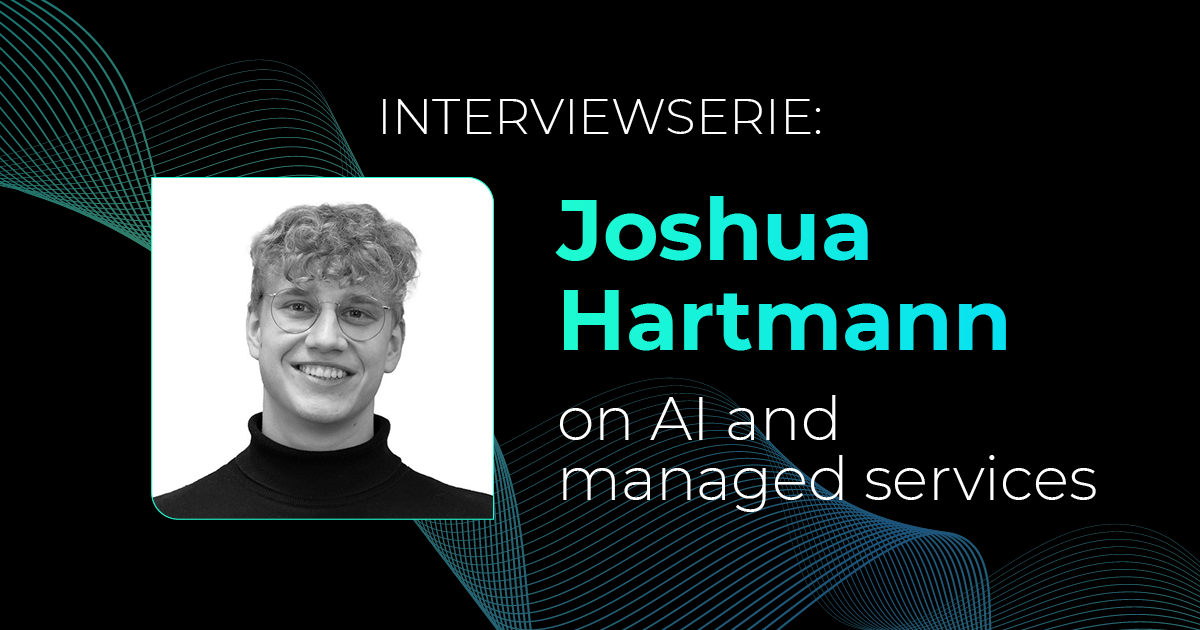

Every story begins with people who make a difference. In our interview series, it is precisely these people who have their say: NWS employees who share their experiences, ideas and insights with us. We want to know what drives them and what we can all learn from them.
We continue our interview series with Joshua Hartmann, Systems Engineer.
What is your role at NETWAYS Managed Services, and what are your responsibilities?
I work on the SaaS team at NETWAYS Managed Services, where I’m responsible for our managed apps. These include Nextcloud, GitLab, Icinga, Prometheus, and our managed AI models, among others. My focus is on ensuring these platforms operate securely, efficiently, and with high availability for our customers—from deployment and monitoring to updates and continuous development.
What developments in the AI field do you find particularly exciting right now?
Two developments stand out to me: First, the rapid advancement of open AI models. Their quality is improving so quickly that operating their own, self-hosted models can become worthwhile for an increasing number of companies. Second, the integration of AI into everyday work: AI assistants in the IDE, for GitOps processes, in knowledge management—such as with Nextcloud—and in support.
How important are data protection and data security when using AI?
For me, this is not a minor issue, but a fundamental requirement. As soon as AI models work with company data, the crucial question is: Where does this data go? Many companies rightly worry that their data will end up with external providers or even be used for training. This is exactly where we come in: Our AI models run in controlled environments, data flows are clearly defined, and compliance with the GDPR is an integral part of our operations. For us, data protection in AI is the foundation on which trust is built.
In your view, what are the biggest challenges when integrating AI into existing processes?
From an operational perspective, I see two main issues: First, most companies don’t have their data in the format that AI models require—it’s too unstructured, too scattered, and not maintained well enough. And second, AI systems don’t just run on their own after implementation—they must be operated like any other infrastructure: updates, monitoring, and quality assurance.
What are currently the biggest challenges in operating modern managed service environments?
Modern environments are a mix of the cloud, self-hosted apps, containers, and now AI models—and all of these must work together reliably. At the same time, security and compliance requirements are constantly increasing, and the pace of technical development is accelerating. And then there’s the issue of personnel: finding and retaining qualified experts for modern infrastructures is becoming increasingly difficult. Anyone who wants to operate all of this in-house needs a large team—which is precisely why more and more companies are outsourcing these operations to specialized partners.
How do you ensure that our managed service systems remain secure and available?
We continuously monitor our environments using Icinga and Prometheus—which, by the way, we operate ourselves as a managed service. We also implement regular security updates, maintain isolated environments, and follow clear operational processes. When it comes to AI models, we also ensure controlled access and traceable data management. And most importantly: open communication with customers. If something happens, we communicate transparently and work on solutions instead of downplaying problems.
What should companies look for when choosing a managed service partner?
I would focus on three points: First, genuine operational expertise—the partner should actually run the technologies they offer as part of their own stack and live with them. Second, transparency: clear processes, honest reporting, and open communication—especially when things go wrong. And third, a collaborative attitude: A good partner advises, explains, and helps drive development, rather than just working through support tickets. And: Security and data protection should be included as standard in the service, not as an extra charge.
What advice would you give to companies that are currently developing their AI strategy or looking to use managed services?
Start small, but with a clear goal. Identify a specific use case where AI delivers measurable value, and build from there. Avoid the temptation to implement AI just for the sake of it, and think about the data from the very beginning: Where does it go, and who has access to it? And if you’re using managed services: Choose a partner who works with you as equals and whose technology stack you can understand.
What technical trend should every company keep an eye on?
For me, it’s the shift from AI as a chat tool to AI as a work tool—that is, AI agents that not only answer questions but also complete tasks on their own. This will change the way companies operate. And closely tied to that is data sovereignty. The more AI becomes a standard tool, the more important the question becomes of where the data is processed and who has access to it. Companies that are thinking about this now—and, for example, run AI models in their own environments—will have a clear advantage later on.

0 Comments