

Cybersecurity-as-a-Service (CSaaS) is a specialized sub-sector of managed services in which external service providers (Managed Security Service Providers, MSSPs) take over the security infrastructure as well as the monitoring and management of IT systems. In view of the increasing threat situation and the shortage of specialists in the field of IT security, this model offers companies the opportunity to raise their security to a professional level without having to build up their own capacities.
The core components of cybersecurity as a managed service are:
- Managed Detection & Response (MDR): proactive search for threats and response to incidents.
- SOC-as-a-Service (Security Operations Center): central monitoring (24/7) of the entire IT landscape.
- Managed endpoint security: management of antivirus and firewall solutions.
- Log management & SIEM: Central evaluation of security messages.
- Identity & Access Management (IAM): Control of access and identities.
- Application security: e-mail security, protection of access data.
- Data security: both in idle mode and during transmission
- Network security: Filter malicious traffic and block potential intruders.
- Cloud security: including multi-cloud environments.
Why is Cybersecurity-as-a-Service important?
Security incidents and cyber attacks are on the rise worldwide. No company is safe from them, regardless of its size or industry. Ransomware, malware, phishing, social engineering, denial of service and other attack methods are on the rise and becoming increasingly complex. To make matters worse, the threats are constantly evolving and cyber criminals are constantly using new methods to trick unsuspecting victims and infiltrate networks. The attackers have a clear goal: they want to gain access to your company’s data. If your data is compromised, it can have devastating consequences for your company.
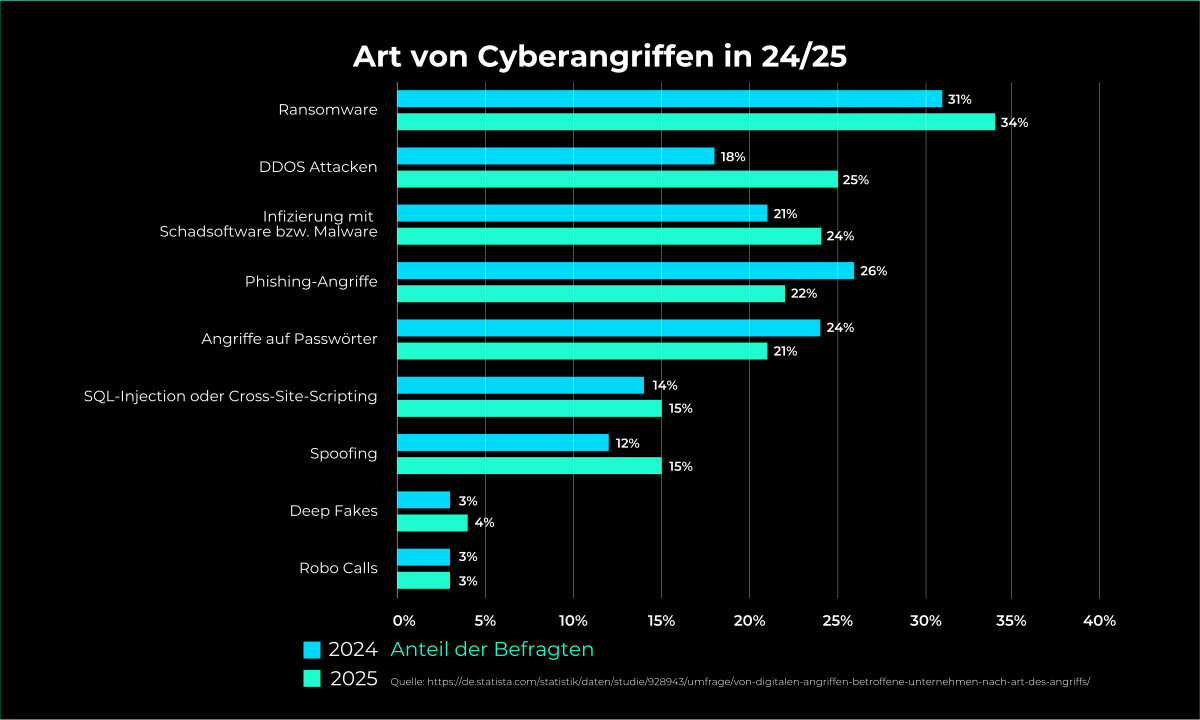
In view of this development, cyber security is now becoming more important. However, this requires appropriate resources and a large team that specializes in cybersecurity and has the necessary knowledge and experience. It is therefore unrealistic to expect every company to have the necessary resources to set up a dedicated Security Operations Center (SOC). In addition, specialists in this area are in high demand and therefore difficult to find. Even medium-sized and large companies find it difficult to provide the resources required to recruit and retain IT security specialists. Small and medium-sized companies quickly reach their limits here. Cybersecurity-as-a-Service is an attractive and more cost-effective alternative to building an in-house security team.
The NWS Newsletter
New products, fresh features and dates for events and talks: everything important from the NWS world, delivered compactly to your inbox.
Advantages of Cybersecurity-as-a-Service
- Relief for internal IT: External experts take over day-to-day operations, freeing up internal capacities.
- 24/7 protection: Cyber attacks do not only occur during business hours. CSaaS providers usually offer 24/7 monitoring so that threats can be detected and averted in real time.
- Cost and planning security: Instead of high initial investments in tools and personnel, companies pay predictable monthly fees. This makes budgeting easier, especially for CFOs, and reduces financial risks.
- Faster response times for security incidents: With automated processes and experienced incident response teams, security incidents can be identified and resolved much faster than would often be possible internally.
- Compliance & certification: Support in complying with security standards (e.g. ISO 27001).
- Access to expert knowledge: The shortage of specialists in the field of IT security is serious. With CSaaS, companies have access to specialized security teams without having to recruit them themselves. These experts are always up to date with the latest threats and technologies.
Typical application scenarios for cybersecurity-as-a-service
Cybersecurity-as-a-Service is suitable for a wide range of use cases:
- Medium-sized companies without their own security team
- Companies with high compliance requirements
- Organizations with hybrid or multi-cloud environments
- Start-ups with rapid growth and limited resources
A professional security strategy is indispensable, especially in complex IT landscapes with cloud, Kubernetes and distributed systems.
How does Cybersecurity-as-a-Service work?
Cybersecurity-as-a-Service combines industry-leading security services, software and the expertise of specialists in a holistic solution.
The providers’ SOCs have experienced security experts who deal with the monitoring, identification, tracking and resolution of security incidents. Professional security software and state-of-the-art tools are used to identify and prioritize threats.
In the CSaaS model, the SOC relies on a combination of technology and human expertise to monitor your systems and applications for security threats. This includes state-of-the-art artificial intelligence (AI), managed detection and response (MDR), managed incident response, endpoint security, application security, data security and cloud security. SOC employees can also proactively search for potential security threats. Various methods are used for this, e.g. social media monitoring, dark web intelligence and open source intelligence.
As a result, these solutions significantly reduce the need for companies to set up their own security tools or processes. Some MSPs can start monitoring the corporate environment within days, providing faster proactive protection than traditional in-house security procedures.
Challenges and what companies should look out for
Despite all the advantages, companies should consider a few points when selecting a CSaaS provider:
- Transparency of services: Which specific services are included?
- Response times (SLAs): How quickly is action taken in an emergency?
- Data protection and location: Where is data processed and stored?
- Integration into existing systems: How well does the solution fit with existing IT?
- Certifications and standards: Does the provider support relevant compliance requirements?
A trustworthy provider is characterized by clear processes, high security standards and transparent communication.
What questions should I ask when choosing a CSaaS provider?
The following questions in particular can be determined from the challenges mentioned when selecting a suitable CSaaS provider:
- What can I expect from this service?
- What aspects of cybersecurity am I still responsible for, even if they are managed by a third-party provider?
- What functions and services does your SOC include?
- Where is your SOC?
- How much expertise does your team have?
- Can you customize your CSaaS solutions to my business needs?
- Do you have an incident response plan for security incidents?
- What kind of reports will I receive?
- Is your service available 24/7?
- Do you offer endpoint security and monitoring?
- How do you secure my data?
- What safety standards and regulations do you follow?
- How do you ensure that the activities of your security analysts do not have a negative impact on my environment?
- How can my existing security tools and platforms be integrated?
Cybersecurity and digital sovereignty
Digital sovereignty is an increasingly important aspect. Companies want to retain control over their data and not become dependent on individual providers.
Cybersecurity-as-a-Service can make an important contribution here – especially when open standards, open source technologies and local hosting options are used. Solutions “Made in Germany” or within the EU offer additional legal security and strengthen trust.
Conclusion
Cybersecurity-as-a-Service is the necessary response to the increasing demands on IT security and the rapidly changing threats posed by cyber criminals. In combination with managed services, a powerful model is created that can relieve your company, minimize risks and offer maximum flexibility at the same time.
Anyone who wants to invest in a sustainable IT strategy today can hardly avoid CSaaS. Companies benefit from greater security, more efficient processes, predictable costs and a clear competitive advantage.

0 Comments