

Digitalization affects all areas and processes of a company. IT managers therefore have to configure, monitor and maintain more and more devices, systems and solutions. However, there is often a lack of resources for this. Managed service providers (MSPs) not only relieve internal IT of routine tasks, but also offer specialist expertise that medium-sized companies in particular can hardly build up themselves.
The shortage of IT specialists is no longer a vision of the future, but a reality in almost all industries. Companies are increasingly struggling to find qualified IT specialists, fill vacancies and at the same time meet the increasing demands for digitalization, security and scalability. This raises a key question for CFOs and HR managers: how can IT services be reliably secured without getting caught up in an endless recruitment cycle?
For many organizations, the answer lies in managed services. In this article, you will learn why managed services are a strategically sensible solution and how they help to bridge staff shortages, accelerate support and optimize costs in the long term.
Skills shortage in the IT sector
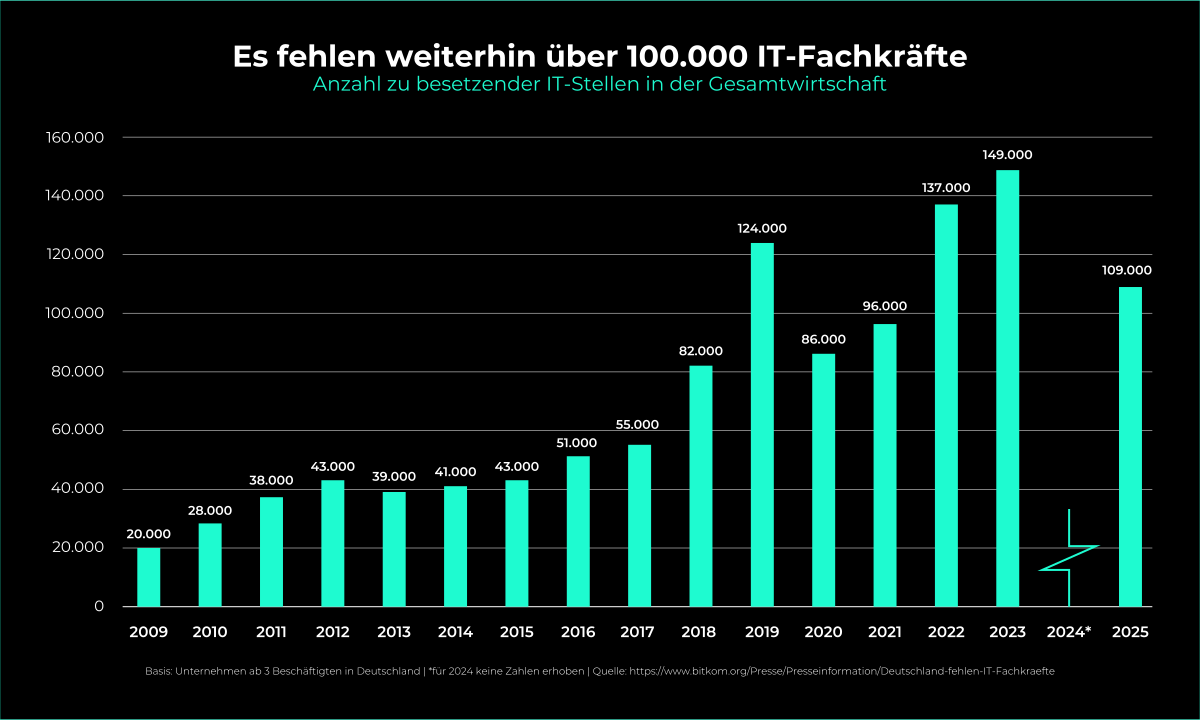
The IT sector is severely affected by the shortage of skilled workers and suffers from many unfilled vacancies. A new record high of 149,000 vacancies was reached in 2022. This means that 100,000 positions will remain unfilled in 2025.
The reasons for the general shortage of skilled workers in Germany lie primarily in demographic trends. This is particularly drastic in the IT sector, as the requirements for data protection, data security and cyber security are increasing daily for all companies. While one person used to be enough to look after the IT systems in a small company, for example, the tasks of the IT department are becoming increasingly complex and specialized with increasing digitalization.
Cyberattacks, data theft and fines Overworked employees often lack the time to continuously check existing systems for updates or to install new security patches promptly. This makes it easy for cyber criminals. The IT department may also no longer be able to continuously monitor the systems, create daily backups and create and implement emergency plans in the event of an attack. This results in numerous subsequent problems, for example in the area of compliance.
According to laws such as DORA or CRA, companies that are part of the critical infrastructure in particular must be up to date with the latest technology in order to protect themselves against cyber attacks. Without a functioning and appropriately trained IT department, this is almost impossible to achieve and there is a risk of high fines. It is therefore imperative for companies to think about alternative solutions for recruiting and retaining specialists.
How you can take the pressure off your IT specialists
The IT department must be relieved of routine tasks so that it can devote its full attention to the digital transformation. This can be achieved in three ways:
- Reduce your own infrastructure: Procuring, configuring, maintaining and securing servers, storage systems and network components is costly, time-consuming and error-prone. Many companies are therefore moving all or part of their IT infrastructure to the cloud and using it as Infrastructure-as-a-Service (IaaS).
- Automate processes: IT administrators use scripts to automate recurring workflows. However, these are not very flexible and are primarily suitable for standardized tasks. With low-code/no-code platforms, even more complex processes can be automated without a great deal of programming effort.
- Outsourcing tasks: Companies can also relieve their IT department by outsourcing individual areas to an external managed service provider.
The NWS Newsletter
New products, fresh features and dates for events and talks: everything important from the NWS world, delivered compactly to your inbox.
What are managed services?
Managed services refer to the outsourcing of defined IT tasks to a specialized service provider. This service provider assumes responsibility for operation, maintenance and support, often around the clock and on the basis of clearly defined service level agreements (SLAs).
The spectrum ranges from infrastructure management and cloud services to the operation of Kubernetes or IT security. Companies have access to an entire team of experts instead of having to build up individual specialists internally.
Typical tasks that a managed services provider can take on
- Monitoring of IT systems: This includes monitoring servers, networks, databases, security systems, etc. in order to identify and rectify potential problems at an early stage.
- Network management: Configuration and administration of the company network, including setting up the firewall, VPN and WLAN.
- Data backup and data recovery: Automatic creation of regular backups of company data so that it can be restored in an emergency.
- IT security: implementation and management of anti-virus programs and malware scanners, configuration of firewalls, performance of security audits.
- Helpdesk support: Supporting users in the company with IT-related problems and queries.
- Software and hardware management: procurement, installation, configuration and updating of software and hardware.
- Scaling and capacity planning: Planning and implementation of measures to scale the company’s IT infrastructure to support growth and changing requirements.
- Consulting and project management: Support and consulting for IT projects – from planning and implementation to success monitoring.
Why managed services are the answer to the IT skills shortage
Immediate access to expert knowledge
Instead of spending months searching for hard-to-find specialists, Managed Service Providers (MSPs) give you immediate access to a pool of highly qualified specialists.
Relief for the internal IT team
You can outsource routine tasks such as monitoring, maintenance and support. This frees up internal staff for strategic projects and innovations.
Higher security level
MSPs specialize in current cybersecurity threats. Through proactive action and modern technologies, they often guarantee a higher level of security than would be possible for internal teams due to a lack of resources.
Fast support and higher availability
Another decisive advantage is speed. Managed services offer 24/7 support, clearly defined response times and proactive monitoring. In concrete terms, this means that problems are detected before they become critical, downtimes are minimized and systems run stably and with high performance.
Plannable expenses
This point is particularly relevant for CFOs: Managed Services transform difficult-to-calculate personnel costs into predictable operating costs.
The hidden costs of recruiting are often underestimated. These include, among other things: Job advertisements and recruitment agencies, time spent on interviews and selection processes, onboarding and induction, staff turnover and re-staffing.
Managed services largely eliminate these factors. Instead of investing in lengthy and expensive recruiting processes, you pay a transparent monthly fee. The result is better planning, lower risk and often significant cost savings.
Scalability without risk
Another advantage is flexibility. Your company can scale Managed Services according to demand without having to hire or lay off new employees.
This is particularly valuable in dynamic environments such as growth, internationalization, seasonal peak loads and short-term projects.
Focus on the core business
When internal resources are no longer tied up in operational IT tasks, there is room for strategic initiatives. Your teams can then focus more on innovation, product development and business-critical projects.
This also has qualitative advantages for HR: employees can use and develop their skills in a more targeted way.
Security and compliance
IT security plays a central role, especially in regulated markets. Managed service providers generally have specialized security teams, up-to-date certifications and standardized processes.
This not only reduces risks, but also makes it easier to meet compliance requirements – another plus point for management and the finance department.
Managed Services: Advantages at a glance
✅ Scalability
You can flexibly adapt your IT resources to changing business requirements without having to invest in expensive hardware or additional staff.
✅ Increased safety
Benefit from regular monitoring of your systems and advanced security measures to ensure protection against cyber threats.
✅ Continuous support
Round-the-clock support ensures that your IT problems are solved quickly and effectively, minimizing downtime.
✅ Access to the latest technologies
Keep up to date with the latest IT developments and integrate innovative technologies into your IT strategy.
Conclusion: Managed services as a strategic lever
The shortage of IT specialists will become even more acute in the coming years. Companies that rely exclusively on internal resources will come under increasing financial and operational pressure as a result.
Managed services offer a convincing alternative here. They enable immediate access to expertise, reduce recruiting costs, improve service quality and create more flexibility at the same time. For CFOs, this means better cost control and less risk. For the HR department, it means less workload in recruiting and more focus on strategic personnel development.
If you want to remain competitive in the long term, you should therefore consider managed services not just as an operational solution, but as an integral part of your corporate strategy.


0 Comments