

The role of IT has changed fundamentally: It is no longer just a cost factor, but also a driver of innovation. At the same time, the requirements for availability, security, scalability and compliance are constantly increasing.
Managed services have long been more than just outsourced IT operations; they are a strategic instrument. The choice of the right solution depends heavily on the individual circumstances and objectives of a company. Standard solutions are quickly ready for use. Customized managed services are ideal for optimally supporting individual business processes and creating competitive advantages. They allow maximum control over the functions and their further development, but require more intensive interaction in the conception and design of the solution. Many companies are therefore faced with a key decision: standardized managed services or individually tailored solutions?
The answer to this has far-reaching effects on the costs, flexibility and innovative capacity of IT.
Why the decision is more critical today than ever before
Modern IT environments are characterized by:
- Multi-cloud strategies
- Containerization and Kubernetes
- Increasing cybersecurity requirements
- Regulatory requirements (e.g. GDPR, ISO 27001)
These dynamics mean that “one-size-fits-all” approaches often reach their limits, while individual solutions are not always cost-effective.
Here is a detailed comparison:
Standardized Managed Services (Standard)
Standardized managed services are ready-made solutions for a broad user group. They are quickly ready for use and cover general business processes. In principle, they are suitable for standard processes that do not differ significantly from one another in most companies.
These predefined service packages are provided by Managed Service Providers (MSPs) in accordance with clear, measurable SLAs (Service Level Agreements).
Typical features
- Clear service description
- High degree of automation
- Standardized processes and tools
- Low degree of customization
Practical examples
- Managed Kubernetes “out of the box”
- Monitoring and alerting platforms
- Patch and update management
- Backup-as-a-Service
Advantages
Fast time-to-market and implementation: ready for immediate use (“off-the-shelf”)
Predefined setups allow services to be provided within a very short time.
This is particularly relevant for:
- new projects
- Short-term capacity requirements
- Proof of concepts
Predictable and transparent costs
Standardized services are usually based on:
- fixed monthly fees
- clearly defined service packages
This makes budget planning and controlling much easier.
High operational reliability
As these services are based on tried-and-tested architectures, companies benefit from:
- stable processes
- Proven security concepts
- Continuous optimization by the provider
Scalability
Standard solutions are designed to grow quickly:
- Resources can be flexibly expanded
- New instances can be rolled out automatically
Limits of standardized solutions
Despite all the advantages, standardized managed services reach their limits in certain scenarios.
- Individual requirements can only be mapped to a limited extent.
- Legacy systems are often difficult to integrate.
- Specific compliance requirements are not fully met.
- Competitive differentiation is hardly possible.
- Little flexibility: Adaptation to specific, unique processes is hardly possible.
- Less differentiation: No competitive advantages are offered by specialized IT.
This can be a decisive disadvantage, especially in complex IT landscapes.
Challenges
- Limited customization options
- Possibly inaccurate mapping of specific business processes
- Possible dependence on the manufacturer for updates and support
Best area of application
- Small to medium-sized enterprises (SMEs)
- Standardized IT environments
- Basic infrastructure
The NWS Newsletter
New products, fresh features and dates for events and talks: everything important from the NWS world, delivered compactly to your inbox.
Tailor-made Managed Services (Customized)
Tailor-made managed services are individually developed operating and service concepts that are precisely tailored to a company’s requirements.
Factors such as:
- Existing IT architecture
- Business processes
- Safety requirements and
- Regulatory framework
taken into account right from the start.
Advantages
Maximum flexibility
Individual solutions can be adapted precisely to your needs.
- specific workloads
- Individual deployment processes
- Customized automation
Seamless integration
Integration is particularly crucial in organically grown IT landscapes.
- Connection of legacy systems
- Integration into existing toolchains
- Adaptation to internal processes
Individual SLAs and support models
You define:
- Response times
- Availabilities
- Support level (e.g. 24/7, dedicated contact person)
Competitive advantages through individualization
If IT is a central part of your business model, a customized solution can be a real differentiating factor.
Challenges of individual solutions
However, individual managed services also present challenges:
- Higher initial costs due to design and implementation
- longer project durations
- Dependence on the service provider
These factors should definitely be taken into account when making a decision.
Best area of application
- Large companies
- complex IT landscapes
- Industries with high security or compliance requirements
Summarized comparison
| Feature | Standardized services | Customized services |
| Customization | Low (standard package) | High (individual) |
| Costs | Lower, calculable | Higher (adjustment costs) |
| Flexibility | Limited | Very high |
| Implementation | Fast | Time consuming |
| Focus | Efficiency & operation | Strategy & process optimization |
| Innovation | Limited | High |
| Differentiation | Low | High |
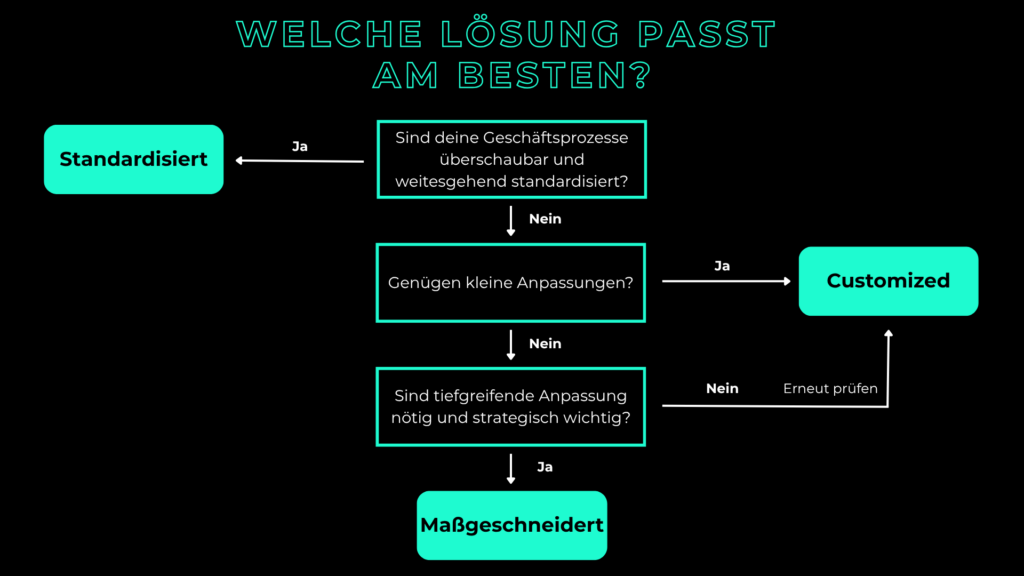
Decision support: How to find the right solution
Clearly define your own requirements
Before looking for a solution, you should take stock of your processes. Which processes need to be mapped? Are there special requirements that not every solution can fulfill? A detailed catalog of requirements helps to narrow down the selection and exclude unsuitable options.
Consider scalability and flexibility
A solution should not only be suitable for your current needs, but should also be able to grow with your company. Fast-growing companies or those operating in a dynamic market in particular benefit from solutions that can be flexibly expanded – be it through modules, interfaces or customization options.
Evaluate the total cost of ownership (TCO)
The acquisition costs alone say little about the cost-effectiveness of a solution. Maintenance, updates, training and possible adaptations often cause additional expenses. A realistic cost analysis over the entire service life provides clarity as to which solution is economical in the long term.
Check integration into the existing IT landscape
Even the best solution is useless if it is not compatible with your existing systems. You should therefore ensure that the new solution can be seamlessly integrated into your existing IT infrastructure. Open interfaces, standardized data formats and integration options are essential criteria for this.
Ensure user-friendliness and acceptance
A solution is only successful if it is actually used by employees. Complex or difficult-to-understand systems can hinder rather than facilitate day-to-day work. Usability tests, pilot projects or the involvement of employees in the selection phase can help you to find a solution that is convincing in practice.
Evaluate support and further development
Technology is constantly evolving and so are the requirements for a solution. You should make sure that the provider delivers regular updates, complies with security standards and offers reliable support. With specialized or tailor-made solutions in particular, it is important to clarify who is responsible for maintenance and further development in the long term.
Ask yourself the following questions to help you decide:
How strategic is your IT?
- Support function → Standardization makes sense
- Business enabler → Individualization necessary
How complex are your systems?
- Homogeneous environment → Standard solutions sufficient
- Heterogeneous, evolved IT → individual services required
What are the regulatory requirements?
- Low requirements → Standard
- Strict compliance → customized solutions
How important is speed vs. perfection?
- Fast implementation → Standard
- Long-term optimization → individual
What is your resource situation like?
- Little internal know-how → Standard services
- Strong internal teams → Individual solutions possible
Conclusion: Which solution is right for you?
The decision depends heavily on your individual situation. Standardized services are ideal for efficiently outsourcing routine tasks (e.g. monitoring, backups). Customized managed services, on the other hand, are necessary if IT is a central component of your competitive advantage and complex, individual requirements need to be met.
To summarize:
- Standardized managed services offer efficiency, speed and cost transparency.
- Customized services enable maximum flexibility and competitive advantages.
👉 The right strategy is the one that optimally supports your business goals – not the most technically complex or cheapest solution.

0 Comments