

Nowadays, it is important for companies to choose the right hosting model to ensure a fast, secure and fail-safe website or application. With the advent of cloud technologies and the evolution of IT infrastructures, two main options have emerged: Managed cloud solution or self-hosting.
But why is this decision so important for companies? Mobile users expect fast loading times and well-functioning applications and websites. If these factors are not in place, many users will leave immediately. In addition, the issue of security is an important point that should definitely be considered in view of the increasing significance of cyber attacks.
So should I opt for a managed cloud solution or operate my own infrastructure via self-hosting? Both options have tangible long-term advantages and disadvantages, both in terms of cost and in terms of control, scalability and security. In this article, we take a detailed look at both models and assess their cost-effectiveness in detail.
Fundamental differences
Managed Cloud
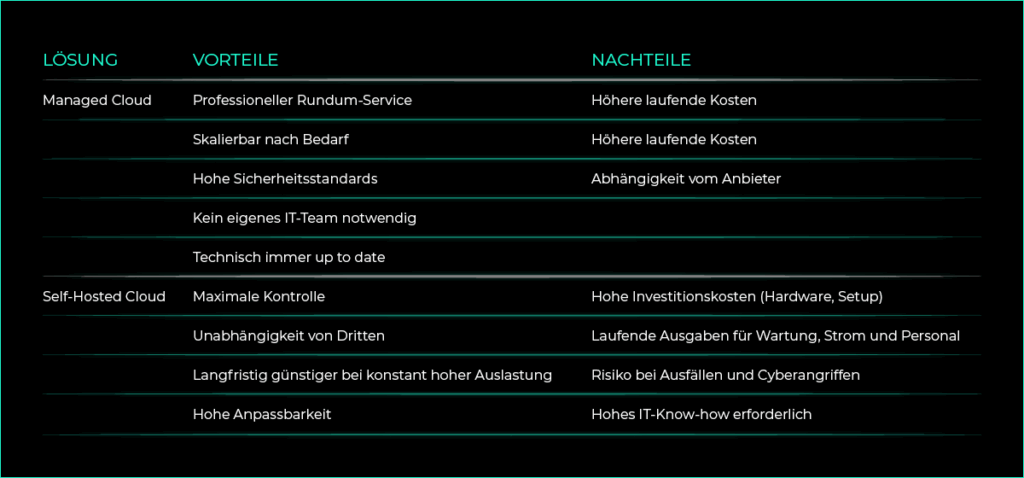
With a managed cloud, an external service provider takes over the administration of the infrastructure. This includes installation, configuration, monitoring, updates, security measures (e.g. firewalls, backups and DDoS protection) and 24/7 support. This allows companies to focus more on their core business, but they are dependent on the service level of the provider. In detail, the managed cloud consists of the following aspects:
Technical factors
- Server setup: The cloud provider is responsible for installing the operating system and configuring the server environment.
- Software updates: Acceptance of regular updates and upgrades.
- Backup services: Perform regular backups to ensure your data is restored quickly.
Security
- Firewalls: Protect your website or application from unwanted access and potential threats.
- DDoS protection: Protection against attacks that aim to paralyze your server by overloading it.
Performance
- Monitoring: 24/7 monitoring of your server to ensure smooth processes and detect potential problems at an early stage.
- Optimization measures: Regular optimizations and adjustments to keep your environment up to date.
- SLAs: These ensure a high level of reliability for your company.
Customer service
- 24/7 support: A team of experts is available around the clock to help you at any time.
- Contact person: For technical questions or general assistance, you also have a dedicated contact person at your side.
- Takeover of the services: Pay-as-you-go or flat-rate models
Self-hosting
With self-hosting, the company operates the infrastructure itself, either on its own servers (on-premise) or in rented data centers. This means full control over hardware and software, but also responsibility for maintenance, updates, security and scaling. The most important factors here are
Technical freedom
- Hardware selection: As a company, you can select the hardware yourself according to your needs.
- Software freedom: Software can also be customized and selected directly for your own needs.
Cost overview
- Acquisition costs: High acquisition costs are incurred due to the independent procurement of the necessary hardware and software.
- Electricity costs: High electricity costs are incurred as the servers have to run around the clock.
- Cooling: The cost of a cooling system should also be taken into account, as servers generate a lot of heat.
- Maintenance and spare parts: Individual parts of your server can always fail and need to be replaced accordingly. You should also allow time for any repairs.
Safety standards
- Your own firewalls: You have to take care of your own security systems, such as firewalls.
- Security updates and backups: You must ensure that all software and systems are up to date at all times. You should carry out regular updates yourself to ensure that your data is available at all times, even in the event of problems.
- Security of your data center: Ensure the security of your servers against theft or sabotage at all times.
Know-how
- IT resource requirements: The need for personnel and the corresponding expertise is continuous and must be covered at all times.
- Independence from cloud providers: By having your own servers and hosting, you reduce your dependence on others, as you can and may take care of everything yourself.
- Troubleshooting: You bear full responsibility in the event of failures or security incidents.
Economic efficiency over time – TCO analysis
The Total Cost of Ownership (TCO) is the decisive factor for long-term profitability. All costs are included over several years.
Self-hosting: initial investment, then ongoing burden
- Initial costs: server, network technology, software licenses
- Operating costs: electricity, cooling, internet connection, maintenance
- Personnel: Administrators and security experts
- Risks: Costs due to outages or cyber incidents
→ Example: A medium-sized company with 500 employees must initially invest several hundred thousand euros in hardware and equipment for a self-hosted solution. Added to this are annual personnel and operating costs in the six-figure range.
Managed cloud: predictable running costs
- Monthly fees depending on the number of users or resource consumption.
- Scalability prevents overdimensioning of the infrastructure.
- Including services such as backups, monitoring and security updates.
- Calculable costs, as risks and maintenance are outsourced to the provider
→ Example: A company opts for a managed cloud with 500 users. Instead of high one-off costs, there are predictable monthly fees, which are often 50-70% cheaper than operating the cloud yourself over several years.
Risks and pitfalls
Managed Cloud
- Vendor lock-in: Switching to another provider can be technically and financially costly.
- Cost overruns: With pay-as-you-go, costs can rise quickly if resources are used in an uncontrolled manner.
- Data sovereignty: Depending on the provider and location, data protection concerns may arise.
Self-hosting
- High complexity: Operation requires a high level of IT expertise.
- Security risks: Attacks must be defended against internally – often with fewer resources than with a provider.
- Scaling problems: Growth means new hardware purchases, which in turn trigger investments.
Decision-making aid: Which solution suits whom?
A managed cloud is worthwhile for:
- Start-ups and SMEs without a large IT department.
- Companies with fluctuating resource requirements.
- Organizations that prioritize flexibility, security and resilience.
- Teams that want to concentrate on their core business.
Self-hosting is worthwhile for:
- Companies with very high, stable and predictable IT loads.
- Industries with extreme requirements for data sovereignty and compliance (e.g. banks, public authorities).
- Companies with a strong internal IT team that can ensure both security and operations.
Conclusion
The question of “managed cloud vs. self-hosted cloud” cannot be answered in general terms. But one thing is clear:
A managed cloud offers planning security, flexibility and often lower overall costs over several years.
Self-hosting can be more economical if IT resources are available anyway, the workload is constantly high and maximum control is required.
Ultimately, an individual cost-benefit analysis is decisive: only those who realistically calculate the total cost of ownership – including hidden costs and risks – can make a well-founded decision for the most economical solution in the long term.

0 Comments