

What exactly are managed services?
Managed services are IT services that a company outsources to an external provider on a permanent or temporary basis. The aim is to avoid having to provide the necessary personnel and technical resources itself. This is intended to increase the company’s effectiveness and flexibility.
This applies in particular if a required resource does not contribute to core value creation, but rather belongs to the company’s ancillary duties.
In contrast to traditional, usually reactive IT support, which only intervenes once a problem has occurred, managed services work proactively. Through continuous monitoring, maintenance and optimization, they ensure that faults do not occur in the first place.
The exact scope of services is defined in a service level agreement (SLA). This precisely defines response times, responsibilities and quality standards. The service provider’s interest is obvious: they want to ensure that your systems are stable and running smoothly at all times and that potential problems are identified and rectified before they affect your business operations.
One example:
Your managed service provider monitors your servers and databases around the clock. If a system fails, it reacts immediately and often before you even notice. Updates, patches and backups are applied automatically and traceably.
You will receive regular reports on:
- System states
- Failures or anomalies
- Performance statistics
- Maintenance carried out
This gives you full control at all times without having to do anything yourself.
What services do Managed Services include?
Many people use the terms “IT support” and “managed services” interchangeably. However, IT support is only one part of the responsibilities of a managed service provider (MSP). The tasks of an MSP can range from infrastructure and application management to business processes.
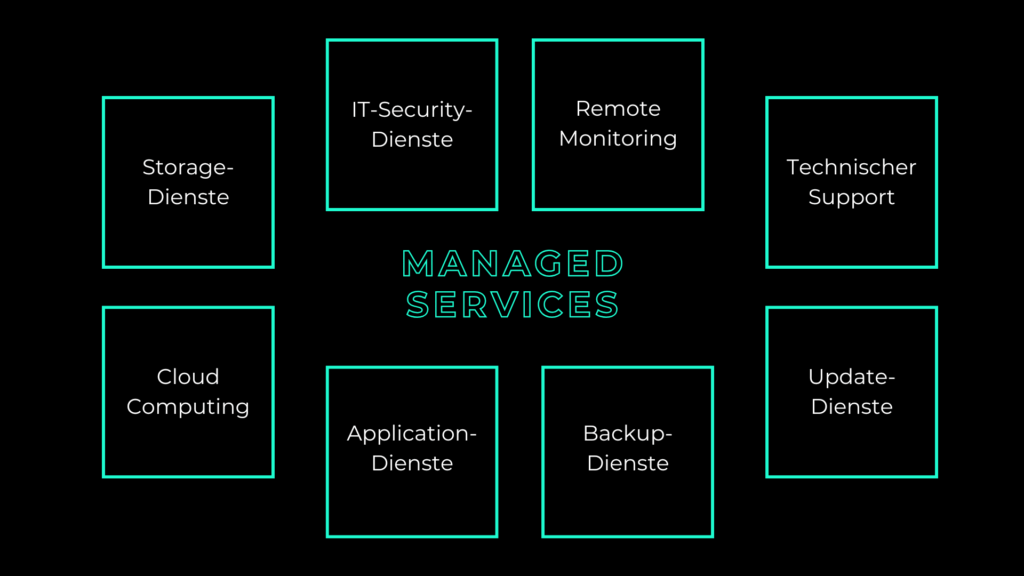
These include:
- Application services: The provider makes the central server applications available, configures them and maintains them.
- Backup services: The provider takes care of a regular backup of your application or company data.
- Cloud computing: Many providers offer to move your IT to the cloud.
- Disaster recovery: In the event of a crash of your IT structure or another accident, your data can be easily restored.
- IT security services: You can place the security of your company’s IT in the hands of a managed service provider. This provider will take care of antivirus protection and firewall solutions as well as network and desktop security, among other things.
- Remote monitoring: The provider you engage monitors your entire IT structure around the clock and can intervene remotely in the event of a fault.
- Storage services: The provision, configuration and maintenance of your storage is the responsibility of the managed service provider.
- Technical support: Your employees can contact the managed service provider if they have technical problems.
- Update services: The managed service provider supports you with the latest updates and patches so that no security gaps can arise in your IT due to outdated software.
A reliable service provider usually has a service desk model. This receives all inquiries and reports via various channels. These are registered as tickets in the information system. The support team either answers each ticket immediately or forwards it to the relevant service department for further processing.
When are managed services really worthwhile?
Managed services are not just for large corporations.
Small and medium-sized enterprises (SMEs) in particular benefit greatly from this, as they do not have to afford expensive expert knowledge on a permanent basis.
Cloud infrastructures, security requirements, data protection guidelines and increasing complexity are putting many companies under pressure. Especially in times of skills shortages and digital transformation, many IT departments simply don’t have the time or expertise to manage everything themselves. A managed service provider closes this gap by taking over routine tasks, ensuring security and at the same time giving you access to specialist knowledge that you don’t have to constantly maintain internally.
They are particularly worthwhile,
when your IT team is at the limit of its capacity.
Many IT departments spend a lot of their time on routine tasks such as updates, monitoring, user administration and backups. These tasks are important to keep everything running, but rarely move the company forward strategically. With managed services, your team can focus on innovation while the provider keeps the foundation stable.
if safety is your top priority.
Cyberattacks, ransomware and data breaches are on the rise.
A managed security service ensures:
- Continuous monitoring
- regular security updates.
- automatic vulnerability scans.
- Emergency and recovery plans.
This significantly reduces the risk of failures or data loss.
if you prefer predictable costs.
Instead of making expensive investments in hardware, software or training, you pay a fixed monthly service fee. This makes IT calculable, transparent and ideal for budget planning and forecasting.
if you want to scale.
If your company grows or introduces new digital services, managed services can grow flexibly with it. You don’t have to hire new employees or purchase additional hardware, your provider simply expands the service package.
if you are dependent on high availability.
Especially with business-critical applications, every failure is expensive.
A managed service provider ensures redundant systems, monitoring and fast response times.
The advantages of managed services at a glance
▶️ Relief for your IT department
Your team is freed from routine tasks and can focus on strategic projects.
▶️ More security and stability
Through continuous monitoring and rapid response to problems.
▶️ Access to expert knowledge
You benefit from experienced specialists without having to hire them yourself.
▶️ Scalability and flexibility
Adapt the scope of services to your company’s development at any time.
▶️ Calculable cost structure
You pay predictable fees instead of unpredictable expenses.
▶️ Faster response times
Faults are detected at an early stage and usually rectified before they have an impact.
Managed services in the cloud: a strong duo
The cloud has made managed services even more attractive.
Many companies now use managed cloud services to take advantage of modern cloud architectures without having to build up in-depth technical expertise themselves.
Examples:
- Managed Kubernetes: Operation and maintenance of container orchestration systems
- Managed Backup & Recovery: Reliable data backup in the cloud.
- Managed monitoring: Monitoring of workloads, networks and applications.
A managed cloud provider ensures that your cloud environment runs stably, securely and efficiently. Security plays a particularly important role in the cloud sector.
Access rights, compliance requirements and encryption must be checked regularly. This is where the support of specialized partners pays off. You are welcome to take a closer look at our range of services.
How to find the right managed service provider
If you want to introduce managed services, choosing the right partner is crucial.
Pay attention to the following points:
- Experience and references: Does the provider have experience in your industry or with similar infrastructures?
- Transparent SLAs: Are services, response times and responsibilities clearly defined?
- Security and compliance certificates: for example ISO 27001, GDPR, BSI basic protection.
- Monitoring and reporting: Regular reports and clear communication are mandatory.
- Flexibility: Can the service grow with your requirements?
- A good sign: Your MSP not only understands technology, but also your business and actively advises you.
Conclusion
Managed services are more than just IT outsourcing: they are a strategic tool that companies can use to modernize, secure and make their IT landscape more efficient. Due to the shortage of skilled workers and the increasing security requirements for IT, companies are facing major challenges. This is where managed services offer a sustainable solution to ensure stability and competitiveness.
Instead of tying up valuable resources in routine tasks such as system updates, backups or monitoring, you can focus on the essentials: Innovation, growth and customer experience. Your managed service provider takes care of operations, ensures security and availability and provides you with the transparency you need to maintain an overview at all times.
Managed services also offer a new level of predictability. Instead of unpredictable expenses and bottlenecks, you benefit from clear cost structures, reliable service levels and scalable services that can be flexibly adapted to your company’s growth.
You decide which areas you hand over and to what extent.
True added value is created where technology meets strategy. A good managed service partner not only understands systems, but also your business goals. They provide you with long-term support, develop your IT architecture further and help you to introduce new technologies securely and efficiently.
Whether you are a small company or a growing SME, managed services are an investment in stability, security and future viability. They give you the freedom to use your IT as a real growth driver and not as a constant challenge.


0 Comments