


We are expanding our cloud server portfolio for optimal and consistent performance of the most demanding applications. Two new additional model series are now available as cloud servers or Kubernetes nodes.
“p” model (performance): These new cloud servers with vCPUs from the AMD EPYC processor family are specially designed for workloads with high performance requirements. Our internal comparison benchmarks showed a performance increase of at least 200% compared to our previous “s” models.
“d” model (Dedicated): With cloud servers from the “d” series, you get dedicated AMD EPYC vCPUs. This means that each “d” flavor VM has exclusive access to the underlying CPU resources and does not have to share them with other VMs on the same host. This guarantees undivided, consistent and reliable top performance.
When performance is crucial
Our new performance-oriented model series are designed for intensive workloads with high computing requirements and the highest demands in professional use.
- Faster CPUs: With state-of-the-art CPUs that are at least twice as fast as our previous standard “s” models, the “p” and “d” models offer a noticeable increase in speed for CPU-intensive tasks.
- Extra bandwidth and disk I/O: Thanks to the new storage I/O limits, even faster NVMe’s and the significantly increased network bandwidths, these models benefit considerably from the increased performance.
- Cost-efficient scaling: As these VMs can handle significantly more workload in direct comparison at a relatively small price premium than the previous “s” models, it may enable companies to reduce the total number of instances required and thus lower infrastructure costs.
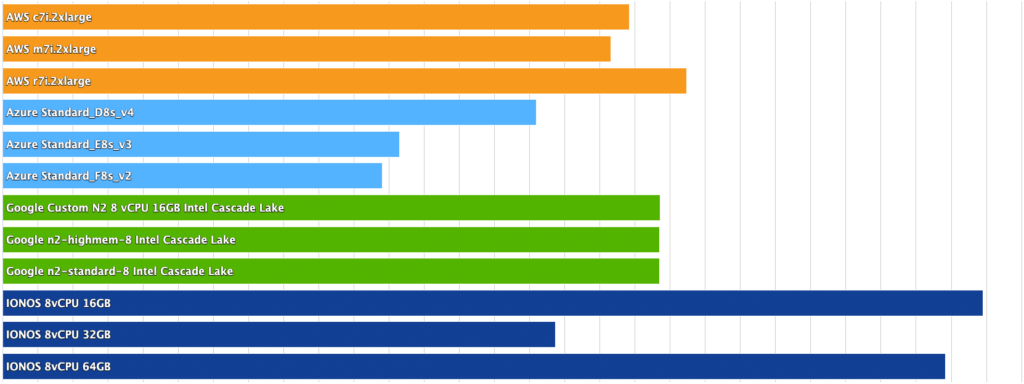
If you compare the virtual machines with equivalent models from our competitors, not only the performance is impressive, but also the price. In the sysbench-cpu test, which calculates prime numbers up to 64000 as quickly as possible and measures the runs per second, we achieve 1475.92 events/s with a p1.large. This is around 80 events/s more than the fastest comparable VM in the benchmark.
At a glance
| Model | vCPUs | Memory | Disk | IOPS Peak volume / local | Bandwidth assured / Max | Price per month |
| p1.small | 2 | 4 GB | 25 GB | 5000 / unlimited | 2.5 / 5 Gbit/s | 22,34 € |
| p1.medium | 4 | 8 GB | 50 GB | 5000 / unlimited | 2.5 / 5 Gbit/s | 44,67 € |
| p1.large | 8 | 16 GB | 100 GB | 5000 / unlimited | 2.5 / 5 Gbit/s | 89,34 € |
| p1.xlarge | 16 | 32 GB | 200 GB | 5000 / unlimited | 2.5 / 5 Gbit/s | 178,68 € |
| p1.xxlarge | 32 | 64 GB | 400 GB | 5000 / unlimited | 2.5 / 5 Gbit/s | 357,36 € |
| p1.xxxlarge | 64 | 128 GB | 800 GB | 5000 / unlimited | 2.5 / 5 Gbit/s | 714,73 € |
| Model | CPUs | Memory | Disk | IOPS Peak volume / local | Bandwidth assured / Max | Price per month |
| d1.small | 2 | 8 GB | 125 GB | 10000 / unlimited | 5 /10 Gbit/s | 73,86 € |
| d1.medium | 4 | 16 GB | 250 GB | 10000 / unlimited | 5 / 10 Gbit/s | 147,72 € |
| d1.large | 8 | 32 GB | 500 GB | 10000 / unlimited | 5 / 10 Gbit/s | 295,43 € |
| d1.xlarge | 16 | 64 GB | 1000 GB | 10000 / unlimited | 5 / 10 Gbit/s | 590,86 € |
| d1.xxlarge | 32 | 128 GB | 2000 GB | 10000 / unlimited | 5 / 10 Gbit/s | 1181,72 € |
A piece of hardware
You get even more undivided performance with our “d” models. Here, our top model d1.xxlarge with 32 vCPUs, 128GB RAM, 2TB NVMe and 10Gbit/s network bandwidth can replace a physical server and is therefore ideally suited for larger database servers or other professional applications.
Conclusion
As organizations strive for more flexibility in their cloud environments, the new “p” and “d” VM models offer targeted solutions for different needs. Whether the power of “p” for compute-intensive tasks or the stability of “d” for mission-critical workloads, these new VM models help companies optimize resources and performance.




0 Comments